

A Luxury Builders CA company
  • Serving all of Orange County
  • Written scope before any work
  • Mon–Sat 8:00–5:00

Tile Roof Repair & Underlayment Replacement in Orange County

Clay and concrete tile roofs fixed at the source. We lift the tiles, replace the worn underlayment under them, and relay the good tiles, so you keep the roof you like and get one that stays dry.

  • Free estimates
  • Written scope before work starts
  • Mon–Sat 8:00–5:00
Concrete roof tiles stacked on a roof while new underlayment and wood battens are rolled out and fastened

The short answer

On many Orange County tile roofs, the tiles aren't the problem. The underlayment under them is. Clay and concrete tile often outlast the felt or membrane beneath, and that layer is what actually keeps water out of the house. The usual fix is a lift and relay: we take the tiles off, install new underlayment (plus battens and flashing as needed), and put the good tiles back, swapping broken ones for matching tiles where they're available.

Clay or concrete: which tile is on your roof?

Most tile roofs in Orange County are one of two kinds.

  • Clay tile is fired clay, the classic look on Spanish and Mediterranean style homes. The color runs through the tile, so it holds up well in the sun. Clay is brittle underfoot and can crack if it's walked on carelessly.
  • Concrete tile is molded concrete, made in flat, S-shaped and shake-style profiles. It's heavy and tough, but the surface color can fade over the years, and it can also crack from foot traffic or a falling branch.

Neither kind of tile is a waterproof layer on its own. Tiles overlap to shed most of the rain, but wind-driven rain and runoff still get underneath. That's normal and expected. What happens to that water next depends on the layer below.

Why the underlayment wears out before the tiles

Think of a tile roof as two roofs. The tiles on top shed water and take the sun. The underlayment underneath, a felt or synthetic sheet laid over the wood roof deck, is the waterproofing. Water that slips past the tiles is supposed to run down the underlayment and off the edge of the roof.

Over the years that hidden layer takes heat trapped under the tiles, dust and debris that hold moisture, and every nail that holds a batten or tile in place. Older felt dries out, turns brittle, then cracks and tears, often first where it bends over battens, in valleys, at the eaves and around vents and chimneys. Once it cracks, water that gets under the tiles has a path to the wood deck and then into the attic.

Meanwhile the tiles can look almost perfect from the curb, which is why replacing a broken tile doesn't always stop a leak: the tile was only the visible part of the problem.

A tile roof that looks fine from the street can still have worn-out underlayment. The clearest way to know is to look under the tiles in a few spots where that can be done safely. We check for it during a roof inspection.

Signs the underlayment under your tile is failing

  • Ceiling or wall stains that show up after the first rains of the season.
  • A leak that comes back after a broken tile was replaced.
  • Water stains, peeling paint or soft wood at the fascia and eaves.
  • Underlayment you can see at the eaves, at a broken tile or in a valley that looks dry, cracked or torn.
  • Tiles that have slipped out of line, which can point to rotted battens or failed fasteners.
  • Water stains, dark spots or damp insulation in the attic, especially below valleys and around chimneys or vents.

One sign on its own doesn't mean the whole roof needs work. It means it's time for someone to look. If you have an active leak, start with roof repair.
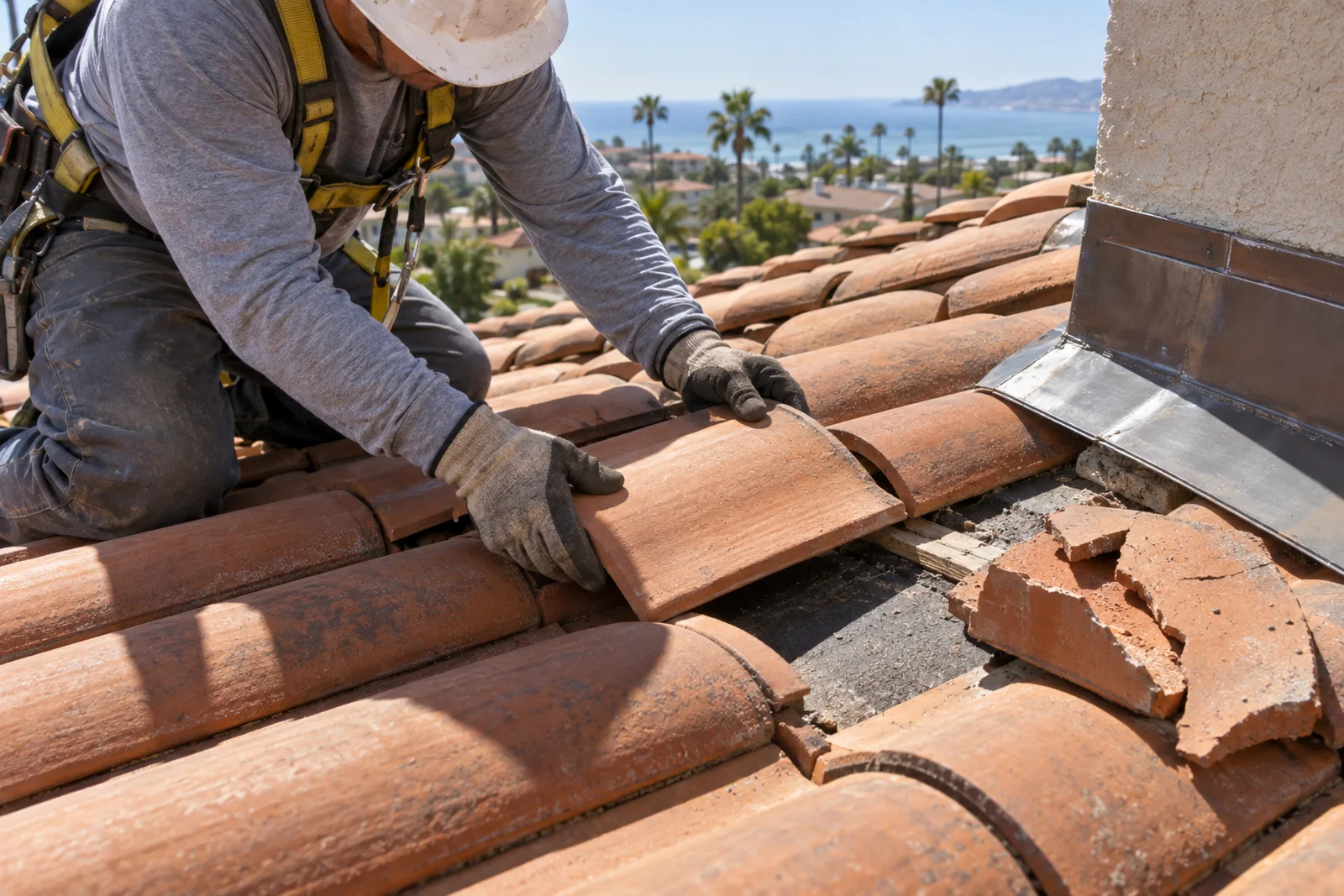
Gloved hands replacing a cracked clay tile on a tile roof
A single cracked tile is usually a small repair. A leak that keeps coming back usually points to the underlayment beneath it.

Battens and flashing: the parts that get overlooked

Battens are the wood strips fastened over the underlayment that the tiles hang on. On many roofs they also lift the tiles slightly so water can drain beneath them. Where water sits against an old batten it can rot, and a rotted batten stops holding tiles in place. During a lift and relay we check the battens and replace any that are rotted, split or no longer hold fasteners well.

Flashing is the metal that seals the edges and joints of the roof: valleys, where the roof meets a wall or chimney, around skylights and vents, and the drip edge along the eaves. Many tile roof leaks start at flashing rather than in the open field of tile. Rusted, bent or caulk-only flashing is best replaced while the tiles are off, when it can be done properly instead of patched from above.

Matching broken tiles

Some tiles are already cracked when we start, and a few more can break when tiles are lifted. We replace them with matching tiles where they're available: the same profile and size, and as close in color as we can find.

Some older profiles and colors are no longer made. When an exact match isn't available, a common approach is to put the original tiles on the slopes you see most and the closest match on a less visible slope. We'll agree on it with you before anything goes back up.

How it works

Lift and relay, step by step.

A new waterproof layer under the roof you already have. The scope is written down before work starts, so there are no surprise costs halfway through.

  1. Inspect and write the scope

    We look at the roof, under tiles where we can and in the attic, take photos, and write down exactly what we'll do.

  2. Lift and stack the tiles

    Tiles are taken off by hand and stacked safely. Cracked ones are set aside to be replaced.

  3. Remove the old underlayment

    The worn underlayment and any rotted battens come off down to the roof deck.

  4. Repair the deck

    Soft or rotted wood is replaced so the new layers go down on a solid, dry deck.

  5. New underlayment

    New underlayment goes on with proper overlaps, carried through the valleys and up the walls, with drip edge at the eaves.

  6. Battens and flashing

    Battens are fastened down and flashing at valleys, walls, chimneys, skylights and vents is replaced or reworked as needed.

  7. Relay the tiles

    The good tiles go back in their courses. Broken ones are swapped for matching tiles where available.

  8. Ridge, hips and clean-up

    Ridge and hip tiles are reset, the site is cleaned up, and we walk you through what was done.

Repair, lift and relay, or full replacement?

There are three ways to fix a tile roof, and the right one depends on what's going on under the tiles, not just on top of them.

ComparedSpot repairLift and relayFull replacement
Best whenA few broken tiles or one leak at a flashing, with sound underlayment around itTiles are mostly in good shape but the underlayment under them is worn outTiles are failing across the roof, or you want a different roof
What's doneReplace tiles, rework flashing or patch underlayment in one areaTiles off, deck repairs, new underlayment, battens and flashing as needed, good tiles relaidTear-off to the deck, deck repairs, new underlayment, flashing and a new roof covering
Your tilesStay in placeReused; broken ones replaced with matchesNew tile or another material
Look of the homeUnchangedEssentially unchangedYour choice
ScopeSmallestThe whole roof, or one section at a timeLargest

Every roof is different. We recommend the option that fits what we find on your roof and put the scope in writing before work starts.

How we decide which one you need

If the leak is in one spot and the underlayment around it is still flexible and intact, a spot repair is the honest answer. If leaks keep showing up in different places and the underlayment we can see is brittle or torn, patching one spot at a time tends to chase the problem around the roof. That's when a lift and relay makes sense. It can cover the whole roof or just the section that has failed.

A full roof replacement is the right call when the tiles themselves are breaking widely, when the deck needs extensive work, or when you'd simply like a different roof. In that case we help you choose the material, and we help you meet California's cool-roof rules where they apply.

We take card, Zelle and Venmo, and financing is available through Luxury Builders CA, our parent company.

Tile roof work across Orange County

We work on clay and concrete tile roofs throughout Orange County, including Mission Viejo, Rancho Santa Margarita, Trabuco Canyon, Lake Forest, Irvine, Laguna Niguel, San Juan Capistrano, San Clemente, Dana Point, Newport Beach, Tustin, Orange and Yorba Linda. See all the areas we serve.

Tile roof questions

Is a lift and relay less expensive than a new tile roof?

Because your existing tiles go back on, a lift and relay avoids buying a full roof of new tile. The cost for your roof depends on its size, pitch and condition, and your written estimate spells out the scope before any work starts.

How long does a lift and relay take?

It depends on the roof's size and pitch, how much deck repair it needs, and the weather. We'll give you a schedule with your estimate.

Can you replace just one broken tile?

Yes. If the underlayment under it is in good shape, replacing a cracked or slipped tile is a straightforward roof repair. If the underlayment is worn, we'll tell you what we saw so you can decide what to do next.

Get a free tile roof estimate

Tell us what you're seeing. We'll look at the roof, explain what's going on in plain English, and put the scope in writing before any work starts.